|


|
Four-Dimensional Stock Market
Structures and Cycles
"READERS CHOICE AWARD" - Stock Trading Systems
Technical Analysis of Stocks and Commodities Magazine
"Book of the Year"
- SUPERTRADERS
Four-Dimensional Stock
Market Structures and Cycles contains the first ten lessons in the course.
The ebook has been combined into a single book for easier
reference.
Although the stock market is used for examples, the techniques
are universal and can be applied to
any market.
This award-winning home-study course teaches market analysts how
to make accurate financial market models predicting price-time
action years into the future. These techniques combine geometry with
cycle analysis to pinpoint turns in both price and time. There are
workbook-like questions/answers producing price and time projections
with accuracy better than one percent.
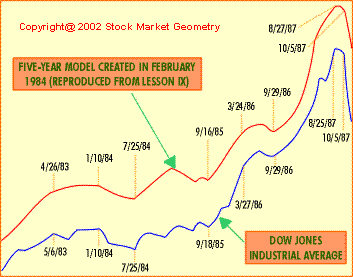
One example of the results obtained by applying
the techniques taught in this course is shown below where a
five-year model of the stock market is shown that was created in
February 1984 using these techniques. The Dow Jones Industrial
Average is shown below the graph for comparison to what actually
happened after this model was made. |
|
This Home-Study Course is the Only Source for
this Information
-
| The material in FOUR-DIMENSIONAL STOCK MARKET STRUCTURES AND
CYCLES is an entirely new way of analyzing financial markets.
YOU HAVE NEVER SEEN THIS MATERIAL BEFORE, because it has never
before been released to the public by any author. Even if you are
the head of technical analysis at the leading brokerage firm in the
country or the world's greatest trader, this material will be new to
you. For example, listed below are just some of the topics uniquely
solved in this course. |
Explains Why the Periodicity of Cycle Bottoms
and Tops Varies
Contemporary cycle analysts have no clue why cycle bottoms
deviate from an ideal rhythm, and why tops wander even more
than bottoms.
Their problem is that they are using the limited
perspective of a two-dimensional price time chart. Without
knowledge of the correct geometry involved, the solution to
this problem remains hidden from view. One of the many topics
covered in Lesson V explains why the periodicity of cycles
vary and teaches the analyst how to anticipate these changes.
Many examples in the DJIA are provided.
|

|
Resolves the Mystery of the Disappearing
52-Month Cycle

|
Analysts have puzzled for years about why cycles suddenly
"disappear." They have tried to explain this phenomenon by using
"beats," i.e., cycles that cancel each other out. However, beats
do not explain why these cycles "reappear" with a phase shift
from their original value. One well-known example of this is the
52-month cycle. It repeated dependably during the 1950s and
1960s, but suddenly "disappeared" in the 1970s, only to reappear
again in the 1980s. |
| FOUR-DIMENSIONAL STOCK MARKET STRUCTURES
AND CYCLES fully explains this phenomenon. After studying
this course, the analyst will understand the nature and cause
of the 52-month cycle, including why it appeared in the first
place. More importantly, the analyst will know what to expect
from this and other cycles in the future.
"Cycles repeat along the face of the geometric
structure that is being completed at that time. When the face
of this structure is complete, the structure rotates to expose
its next face. The cycles on this new face have a phase shift
from the cycles on the previous face." ...page 124 from
the course
If the analyst is to accurately project financial market cycles
he must be able to answer the critical questions of when and where
the face of the geometric structure will complete. There is no guess
work in determining in advance when a geometric growth pattern will
complete. Using the techniques outlined in this course, the exact
dates and prices when the growth pattern will complete can be
pinpointed 100 YEARS OR MORE in the future. The only
limitation is the resolution of the available historical data and
the homogeneity of the index used.
|
Geometry Combined With Cycles Pinpoints
Future Market Turns
When market geometry
is combined with our unique form of cycle analysis, the result
is unmatched in its ability to accurately project future
turning points in both PRICE AND TIME. Turning points can
then be projected years into the future, as well as the daily or
hourly swings.
The results produced by applying the techniques in this course
produce errors of less than one percent even when calculated
over time periods extending for decades. This is not a
"theory only" course. Emphasis is on direct practical
application of projecting market turning points, IN BOTH
PRICE AND TIME.
|
 |
|
FIVE-YEAR STOCK MARKET
MODEL
|
| For example, look at the accompanying figure.
The top line is the model that was created in 1984 to project
the stock market for the next several years. The bottom line is
what actually happened.
EVERY TURNING POINT WAS PREDICTED BY THIS MODEL! i.e., the
bottom in August, 1982; the top in January, 1984; the bottom in
July, 1984; the bottom in September, 1985; the sideways churning
market during March-September, 1986; the major top in August,
1987; and the "crash of October 1987". Lesson IX walks you
through the process that was used to create this model
step-by-step.
FOUR-DIMENSIONAL STOCK MARKET STRUCTURES AND CYCLES not only
teaches the analyst how to make his own models for any time
period desired, past or future, but also how to increase the
resolution well beyond that graphed in the accompanying figure.
|
Two-Dimensional Price-Time Charts Do Not
Accurately Represent Price-Time Action

|
However, with the tools presented in this course the analyst will
learn how to precisely measure the true four-dimensional
structures containing the action. |
More importantly, he will learn how to build
his own future models. One of the best traders in history was W.
D. Gann. He wrote in his Master Course For Stocks:
- "The square and the triangle form within the circle but
there is an inner circle and an inner square, as well as an outer
square and an outer circle which prove the fourth dimension
in working out market movements."
FOUR-DIMENSIONAL STOCK MARKET STRUCTURES AND CYCLES is the
only work ever produced that identifies, precisely measures, and
projects into the future the four-dimensional structures of which W.
D. Gann spoke.
|
A PhD Or Computer Is Not Needed To Understand
This Course And Implement The Techniques
Although the title of
this course may seem a little imposing, it is not as difficult a
concept as you might think. Price and time changes unfold in
growth patterns that can be measured with simple geometry, that
is the first part of the course.
The "Four-Dimensional" part comes into play when you add the
time element. The first three dimensions are length, height, and
width of the geometric structure and the fourth dimension is
time as the price-time chart unfolds. NO COMPUTER OR SPECIAL
SOFTWARE IS NEEDED.
|

|
The Scientific Basis Of Financial Market Geometry
Market price changes
occur within the confines of predetermined points of force. The
relative locations of these points form clearly defined
geometric structures.
|
 |
Scientific applications of this phenomenon are found
throughout nature. Geologists apply the "crystal lattice"
structure to classify minerals by looking at the geometric
arrangement of their planes of cleavage. Similarly, chemists can
identify an element by looking at the geometry of its
constituent atoms.
Financial markets also exhibit a characteristic geometric
lattice as they unfold in price-time. When the geometric pattern
of a financial market is understood projections can be made, not
only in the dimension of price, but also in the dimension of
TIME. This course provides example after example, covering a
period of over 200 years, proving that the geometric approach to
market timing can pinpoint exactly WHEN AND WHERE a
market will reverse direction, well within the resolution of the
available data. For example, the top of the market in August,
1987 was one of the easiest turning points ever to identify.
This home-study course shows how completion of this growth
process was timed years in advance within TWO POINTS and
TWO TRADING DAYS! This type of accuracy is not a fluke.
Every movement the market makes occurs within the confines of
geometric structures which can be understood after mastery of
the material in this home-study course.
|
Geometry Is The Market Analysis Of The 21st
Century
If you are still
using the obsolete tools of Elliott Wave, conventional cycle
analysis, or one of the other methods that has been beaten to
death over the years by thousands of traders and analysts, then
you are aware that all these techniques produce unreliable and
inconsistent results.
Even the so-called
"experts" on these methods acknowledge the great limitations of
their approach. These methods are obsolete, subjective, and
dangerous to risk money on.
Course Description
|
 |
|
Course-Part I |
Course-Part II |
Gann Courses |
Long-Term Data | Catalog
Place Order |
About the Author |
Market Calls |
Testimonials |
Privacy Policy |
Home


Copyright© 2022 Stock Market Geometry. All Rights Reserved
|